
Life in Dubai · 8 min read
Dubai Keeps Building. Who Will Live in All These Homes?
Who will live in Dubai’s new homes? Explore population growth, reasons for moving and everyday life, with a realistic look at housing demand.
By Rota Prime Estates LLC · Originally published: · Updated:
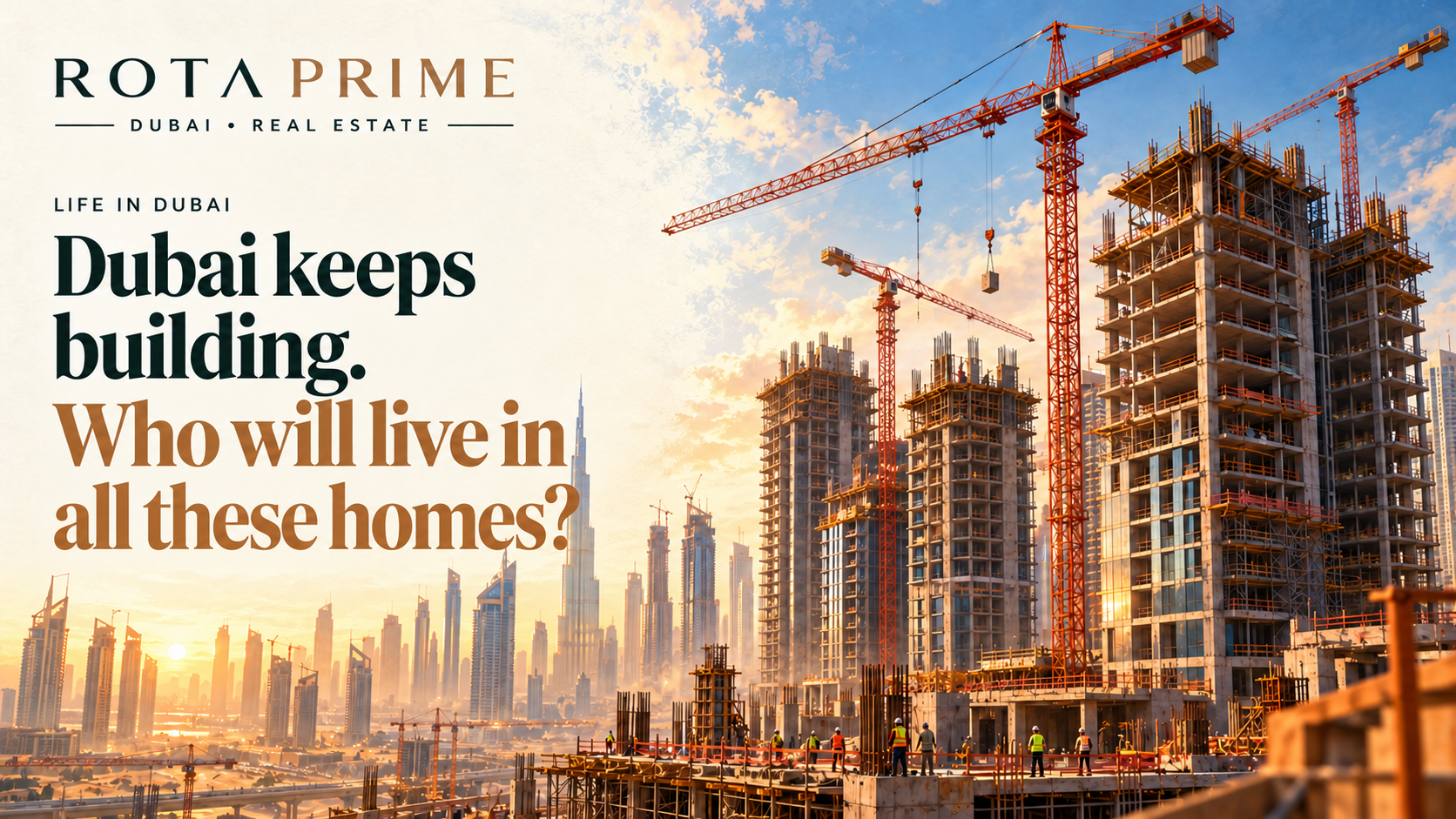
Spend a few days in Dubai and you will probably ask the same question. There is a newly completed community on one side of the road, a tower rising on the other, and a project billboard a little further along. The cranes seem remarkably committed to their jobs.
“Who is going to live in all these homes?”
It is a fair question. If you are considering buying property here, it is also an important one. Project brochures can tell you what is being built. To understand demand, you need to look at the people making a life in the city, too.
The future tenant of an apartment might currently be considering a job offer in another country. They do not have a Dubai address yet. But the city may already be part of their plans.
Start with the population figures
Digital Dubai reported on 30 July 2026 that the emirate’s resident population reached 4.58 million at the end of 2025, an increase of approximately 332,000 over the previous year. The updated official series puts the end-2024 population at around 4.25 million. [1–2]

Source: Digital Dubai, 30 July 2026; Dubai Fact Sheet.
That is a substantial increase in people who work, travel, shop and need somewhere to live. It is not, however, a count of 332,000 immigrants. Nor does it mean that Dubai needs exactly 332,000 additional homes.
Families share a home. Some employees share accommodation. A newcomer may start with a short-term stay before choosing a neighborhood. Treating every additional person as a separate household would be rather like booking an entire restaurant table for each wedding guest. A large number, certainly. A useful calculation, not really.
Population growth is a valuable starting point. The next questions are who these residents are, how they live and what they can afford.
People move for more than a good photograph
Dubai’s social-media image is familiar: a view, a restaurant, a pool, another view. The decisions that persuade people to pack up their lives tend to be more practical.
In InterNations’ 2026 survey, 55% of respondents in the UAE cited work-related reasons for relocating, while 80% said the move had improved their career opportunities. Those UAE-wide participant experiences offer a useful perspective on why people move. [3]
Someone receives an offer for a regional role. Another person wants to be closer to clients. A business owner considers a base from which to reach different markets. None of these examples automatically points to the same housing budget or neighborhood.
There is measurable business activity behind the story. DMCC reported welcoming more than 2,300 new companies in 2025, taking its membership above 26,000. The activity in this one business district illustrates a story that extends well beyond holiday bookings. [4]
Sometimes the attraction is getting an ordinary job done
Salary matters when you move. So does the part of life that never appears on a payslip.
Not losing a lunch break to a routine bill. Finding the options for a vehicle-related task on your phone instead of working out which office to visit. Having a little more of the evening left for yourself. These are not spectacular selling points in a glossy brochure. They matter when you are trying to run an ordinary week.
DubaiNow brings together more than 250 services from over 35 entities. Examples include DEWA bills, Salik and nol top-ups, vehicle-registration renewal and certain tenancy services. Having many everyday services in one place is a tangible convenience. [5]
Sometimes people are not looking for extraordinary luxury. They would simply like to sort something out and get on with their day. A city that makes that easier can become a more convincing place to call home.
Feeling comfortable matters too
Moving is not only a question of what you might earn. You also ask how you will feel and whether your family will be comfortable. An evening walk after dinner or a relative exploring the city independently is an ordinary plan. Feeling at ease about it matters.
In InterNations’ 2026 survey, 94% of UAE respondents rated personal safety positively. That measures participants’ perceptions, but it offers a useful window into the sense of security people value when choosing where to live. [8]

Source: InterNations 2026. Fieldwork: 1 February–31 March 2026.
Learning a new country already takes energy. If parts of everyday life feel more predictable, having more of that energy left for work, family or yourself can be an attractive prospect.
Let’s try it for a while
Not everyone arrives with a lifelong plan. Most people would struggle to make that promise on their first day anywhere.
The first priority may be an apartment near work. Then routines develop. Friendships form and weekends acquire familiar habits. Later, the conversation might turn to an extra room, a different neighborhood or staying longer as a family.
For people who qualify, longer-term residency options can also affect planning. Green Residence, for example, offers eligible categories a renewable five-year residence option without a sponsor. Eligibility and application conditions need to be assessed. [6]
For housing, the interesting point is that the same resident may look for very different homes at different stages. A practical apartment at first, perhaps more space to work from home later. Population growth matters, and so does the way existing residents’ lives evolve.
Not everyone is shopping for a luxury villa
If Dubai’s housing story is told only through its most expensive properties, much of the city disappears from view.
A professional living alone may prioritize transport and total monthly expenses. A couple may want more living space. A family may focus on daily journeys. Another tenant may care far more about proximity to work than an impressive entrance lobby. Within the same city, people are looking for quite different things.
“More people are moving here” is therefore not a complete case for a particular property. You should be able to describe its likely occupant and explain why they would choose it. If the only person you can picture is an investor, it is worth thinking harder about who will eventually live in the home.
A good life still has a budget
You do not need to ignore the costs to appreciate Dubai. Rent, schooling, transport and everyday spending can add up. Summer heat and the journey to work may matter more to an individual household than a beautiful balcony photograph.
In the same InterNations survey, 34% of UAE respondents said their disposable household income was insufficient for a comfortable life. A sensible relocation plan makes room for a monthly budget as well as the possibilities ahead. [3]
Housing markets do not move in one direction without interruption, either. Cushman & Wakefield Core’s second-quarter 2026 report recorded a 4% quarter-on-quarter fall in citywide sale prices and a 6% fall in rents. Differences between neighborhoods and property types need a closer look. [7]
This is why population data is useful context rather than an investment decision on its own. A growing city can contain homes with strong demand and others that take longer to find an occupant because of pricing, location or competition.
Look past the crane and picture the resident
A project announcement is not a completed home. A completed home is not automatically an occupied one. Timing, price, competing supply and practical needs sit between those stages.

Illustrative concept only; not quantitative data or a distribution.
When considering a property, ask:
- Who would live here, and why would they choose this location?
- How does the total cost compare with similar homes?
- What other housing is expected to be delivered nearby around the same time?
- Are transport links and neighborhood improvements already available, or still planned?
- Is the rental expectation supported by current comparable properties?
These questions need not spoil the excitement. They give it something solid to stand on.
So who will live in all these homes? New residents, people whose circumstances change, and households moving to suit their work or family life. That broad answer does not mean every new property will fill at the same speed.
The towers are the easy part to notice. The more interesting story is the lives taking shape between them: people getting home from work, making the most of a weekend and hoping to plan a little further ahead. Familiar ambitions, wherever you come from.
At Rota Prime, we think a property discussion should include who would want to live in the home and why. Tell us about your budget and plans, and we can explore concrete options and the neighborhoods that may suit them.
Sources
- [1] Digital Dubai — 30 July 2026; end-2025 resident population
- [2] Dubai Government Fact Sheet — Updated official end-2024 population series
- [3] InterNations Expat Insider 2026 — UAE — Survey fieldwork: 1 February–31 March 2026; UAE respondents
- [4] DMCC — 14 April 2026; company figures for 2025
- [5] Digital Dubai — DubaiNow — App services; checked 24 October 2026
- [6] ICP — Green Residence — Residency scope and eligibility; checked 24 October 2026
- [7] Cushman & Wakefield Core — 24 July 2026; Dubai residential report for Q2 2026
- [8] InterNations Expat Insider 2026 — Quality of Life — 2026 UAE respondents’ perception of personal safety
Sources checked on 24 October 2026. Numbers in the article refer to the sources below.